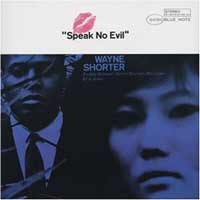
On his third date for Blue Note within a year, Wayne Shorter changed the bands that played on both Night Dreamer and Juju and came up with not only another winner, but also managed to give critics and jazz fans a different look at him as a saxophonist. Because of his previous associations with McCoy Tyner, Elvin Jones, and Reggie Workman on those recordings, Shorter had been unfairly branded with the "just-another-Coltrane-disciple" tag, despite his highly original and unusual compositions. Here, with only Jones remaining and his bandmates from the Miles Davis Quintet, Herbie Hancock and Ron Carter on board (with Freddie Hubbard filling out the horn section), Shorter at last came into his own and caused a major reappraisal of his earlier work. The odd harmonic frameworks used to erect "Fee-Fi-Fo-Fum," with its balladic structure augmented with a bluesy regimen of hard bop and open-toned modalism, create the illusion of a much larger band managing all that timbral space. Likewise on the title track, with its post-bop-oriented melodic line strewn across a wide chromatic palette of minors and Hancock's piano pushing through a contrapuntal set of semi-quavers, the avant-garde meets the hard bop of the '50s head on and everybody wins. The loping lyric of the horns and Hancock's vamping in the middle section during Shorter's solo reveals a broad sense of humor in the saxophonist's linguistics and a deep, more regimented sense of time and thematic coloration. The set ends with the beautiful "Wild Flower," a lilting ballad with angular accents by Hancock who takes the lyric and inverts it, finding a chromatic counterpoint that segues into the front line instead of playing in opposition. The swing is gentle but pronounced and full of Shorter's singular lyricism as a saxophonist as well as a composer.
(by Thom Jurek, All Music Guide)
As his latest album, the epic triple-set Emanon, clearly shows, the comic-book-obsessed saxophonist dubbed “The Newark Flash” is still going strong at 85. Back in December 1964, when Speak No Evil was recorded, Shorter, then 32 and whose day job was with the Miles Davis Quintet, was in the middle of a tremendously fertile spell that would spawn six albums for Blue Note in an intense 18-month period. Though they were all of a high quality, Speak No Evil – on which Shorter is joined by fellow Miles band members Herbie Hancock and Ron Carter, plus trumpeter Freddie Hubbard and Coltrane drummer Elvin Jones – was exceptional. Ever since his apprenticeship in Art Blakey’s Jazz Messengers, Shorter had shown both skill and ingenuity as a composer, and Speak No Evil demonstrates why Miles Davis recorded so many of the saxophonist’s tunes. His horn themes, often snaking and sinuous, as on the title track and the propulsive opener, ‘Witch Hunt’, are unorthodox but also supremely elegant. Every track is a winner, but the ballad ‘Infant Eyes’, now regarded as a jazz standard, is especially noteworthy.
(www.udiscovermusic.com)
The biggest and brightest jewel in Wayne Shorter’s crown, Speak No Evil stemmed from an intensely creative purple patch in 1964 that resulted in three high-quality Blue Note albums (the other two were Night Dreamer and Juju). Backed by the dependable and inspiring Freddie Hubbard, Herbie Hancock, Ron Carter, and Elvin Jones, Shorter, then the leading supplier of material in the Miles Davis Quintet, impresses as both a composer and improviser. His compositions, with their serpentine melodies, all possess an alluring, mysterious beauty. Highlights include “Infant Eyes,” a haunting ballad now regarded as a jazz standard, along with “Dance Cadaverous” and the faster title song with its earworm motifs.
(www.udiscovermusic.com)
 Plattentipp