Fulfilling the potential promised on his Blue Note debut, Night Dreamer, Wayne Shorter's Ju Ju was the first really great showcase for both his performance and compositional gifts. Early in his career as a leader Shorter was criticized as a mere acolyte of John Coltrane, and his use of Coltrane's rhythm section on his first two Blue Note albums only bolstered that criticism. The truth is, though, that Elvin Jones, Reggie Workman, and McCoy Tyner were the perfect musicians to back Shorter. Jones' playing at the time was almost otherworldly. He seemed to channel the music through him when improvising and emit the perfect structure to hold it together. Workman too seemed to almost instinctively understand how to embellish Shorter's compositions. McCoy Tyner's role as one of the greatest jazz pianists of all time was played here as well, and his light touch and beautiful, joyful improvisations would make him a much better match for Shorter than Herbie Hancock would later prove to be.
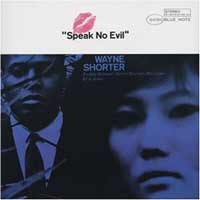
JuJu rests in the uphill portion of Shorter's creative peak. While the sidemen may have been an even better match for him than the ensembles he would put together for later albums, he was just beginning to find his footing as a leader. His performances were already showing evidence of great originality -- yes, they were influenced by Coltrane, but only in the way that they broke apart the structures of the bop sound to create a sound that had all of the variety and flexibility of the human voice. On later albums like Speak No Evil and The Soothsayer, however, Shorter would rise to an even higher level as a performer with more powerful, confident playing that reached farther afield in its exploration of melodic textures.
What really shines on JuJu is the songwriting. From the African-influenced title track (with its short, hypnotic, repetitive phrases) to the mesmerizing interplay between Tyner and Shorter on "Mahjong," the album (which is all originals) blooms with ideas, pulling in a world of influences and releasing them again as a series of stunning, complete visions.
(by Stacia Proefrock, All Music Guide)
New Jersey-born Shorter rose to fame as a composer and tenor saxophonist for Art Blakey’s Jazz Messengers between 1959 and 1963 before joining Miles Davis’s band. It was while he was with Davis that he began recording as a leader for Blue Note. JuJu was his second LP for Alfred Lion’s label and featured him in a quartet setting alongside pianist McCoy Tyner, bassist Reggie Workman and drummer Elvin Jones from John Coltrane’s quartet. JuJu proves to be an inspired musical collaboration that allows Shorter to shine as both a player and composer. His saxophone lines are taut and muscular – except on the tender ballad, “House Of Jade” – while his compositions, often defined by snaking melodies and elliptical structures, brim with a bold invention.
(www.udiscovermusic.com)